I earn money through affiliate links on this site. Links labeled "Affiliate Link" may result in commissions at no extra cost to you. I recommend resources based on my experience and/or very careful evaluation of their usefulness to this site's audience. Content on this site, including text, images, & audio/video (which may include voiceovers), may be generated with the assistance of AI technology.

MouseClickTutorials.com

Teaching people how to make websites...
...and how to make websites make money!

3. Create > D. Menus

3. Create > D. Menus

Understanding Menus in WordPress

Menus in WordPress are essential for organizing your site’s navigation. They provide visitors with easy access to key content by grouping and displaying links in a structured way. What makes WordPress menus powerful is their flexibility—you can add a variety of items, including pages, posts, categories, tags, and custom links, allowing you to create a navigation system that suits your site’s structure and goals.

What Makes WordPress Menus Unique?

WordPress menus allow you to do more than just link to pages. You can:

  • Include posts to highlight specific content.
  • Use categories or tags to let visitors browse grouped content, such as articles on a shared topic.
  • Add custom links to direct users to external websites or other parts of your site, such as a specific section or downloadable resource.

Menus can also be hierarchical, meaning you can create dropdown menus by nesting items. This lets you organize content at multiple levels, making it easier for visitors to navigate through complex sites. For instance, top-level menu items can have submenus containing related links.

MOUSE CLICK BY MOUSE CLICK

1 of #
MouseClickRecording.com will be used to create practice menus

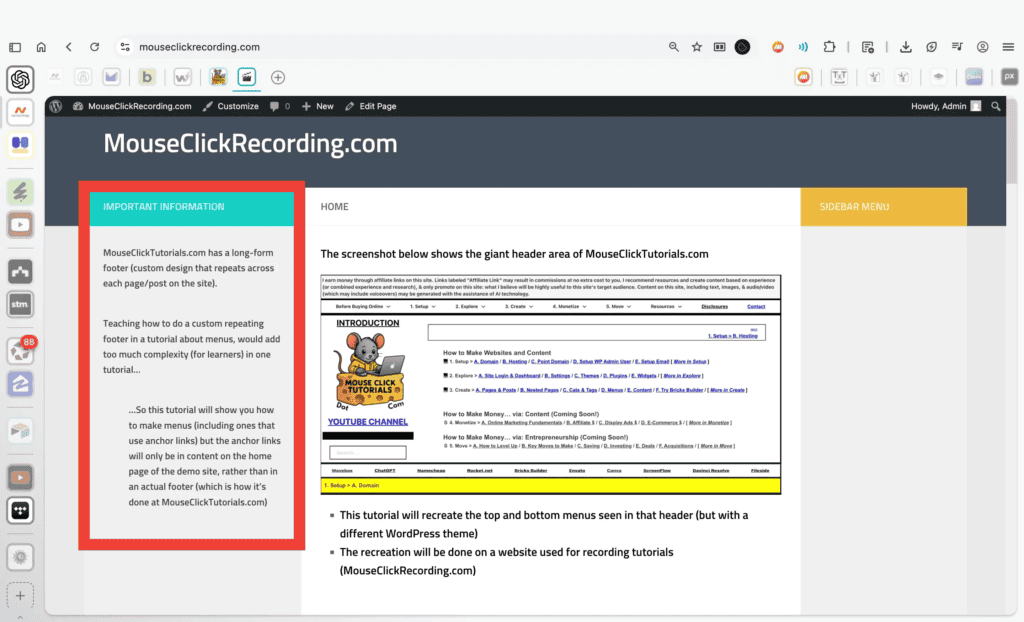
On MouseClickTutorials.com there are two main menus (and each main menu is displayed in the site’s header and footer).

In this tutorial, the two menus will be recreated in a practice-site’s header, and the menu for the green light (super highly recommended) resource reviews will be shown (a second time) on the sidebar on the right side of the theme so you can also learn how to put a menu into a widget area.

2 of #
How the Footer Is Represented in This Tutorial

On MouseClickTutorials.com, the footer includes extra sections that repeat across every page and post.

Recreating that full custom footer here would add unnecessary complexity — this tutorial is focused on menus, not site-wide design.

For demonstration purposes, a simplified version of that area has been placed inside the home page content of the demo site. It contains headings and placeholder text to represent the different sections normally found in the footer.

That setup makes it possible to show how certain menu links point to specific areas within a page or post — without needing to build a true repeating footer.

Most of the menu links you’ll create are standard links that go to other pages or posts. Only a few will use this jump-to-section style, which you’ll learn about later in the tutorial.

3 of #
A Quick Note About Multi-Pane Browser Layouts

Some browsers support multi-pane layouts, where you can view two or more tabs side by side in the same window.

For WordPress work, a two-pane layout is usually the most practical.

It lets you keep the backend on one side (your WordPress Dashboard) and the frontend on the other (the public-facing site visitors see).

That makes it easy to update something in the Dashboard and check it on the live site without switching tabs.

A two-pane layout is also helpful when working between a real site and a demo site.

You can reference things like post titles or structure from one site while setting things up on the other.

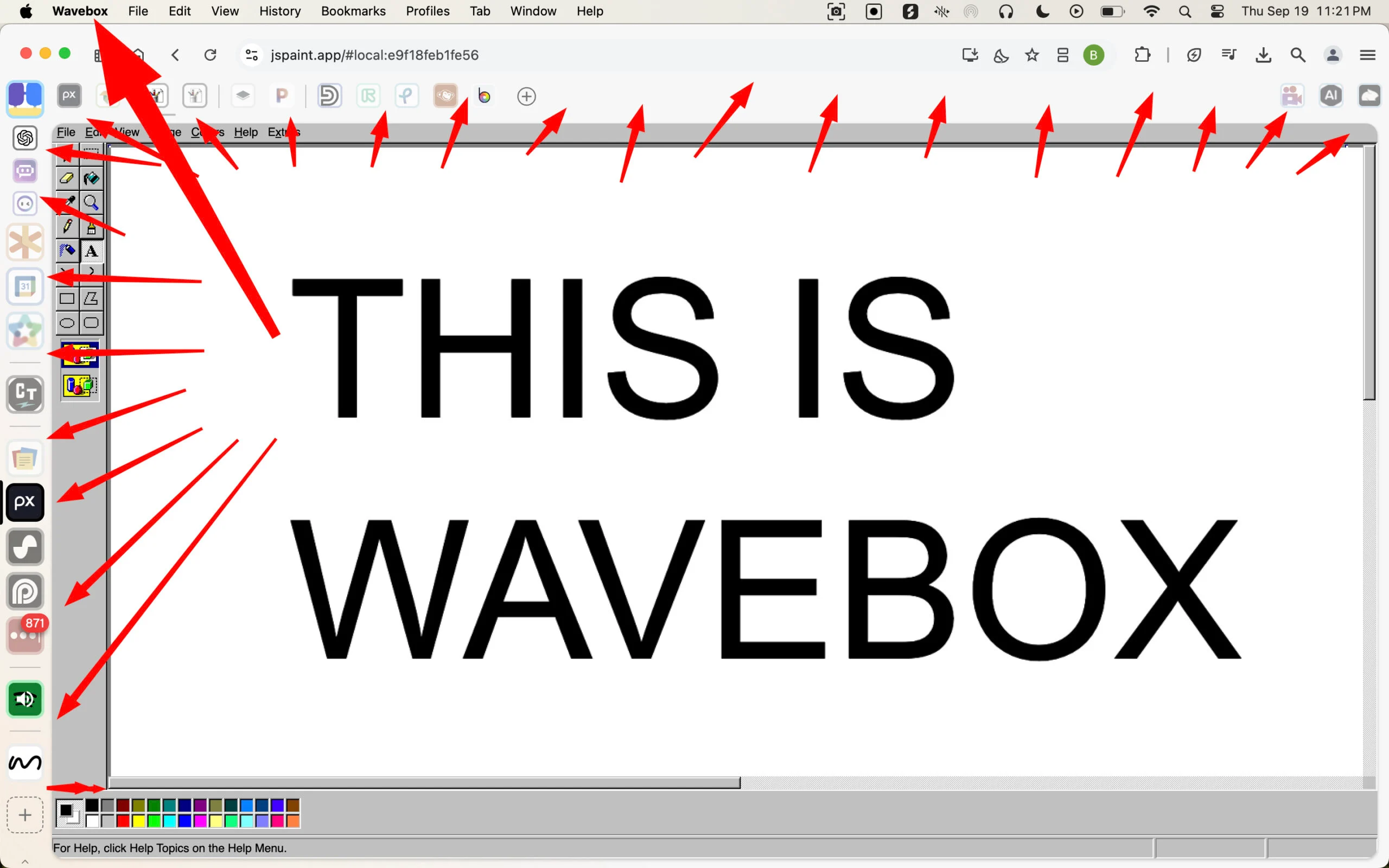
Wavebox is one browser that offers multi-pane layouts.

It supports two panes, three panes, and even a four-pane view — though anything beyond two panes is usually more than most people need.

Nothing in this tutorial requires a multi-pane layout, and you don’t need Wavebox to follow along.

It’s simply an optional workflow improvement that can make cross-referencing faster when moving between different parts of a project.

4 of #
Create a New Menu

Go to Dashboard → Appearance → Menus.

Type a name into the Menu Name box.

Choose the menu locations you want this menu to appear in. (The locations available depend on the theme you’re using.)

Click Create Menu.

5 of #
Add a Page to a Menu in WordPress

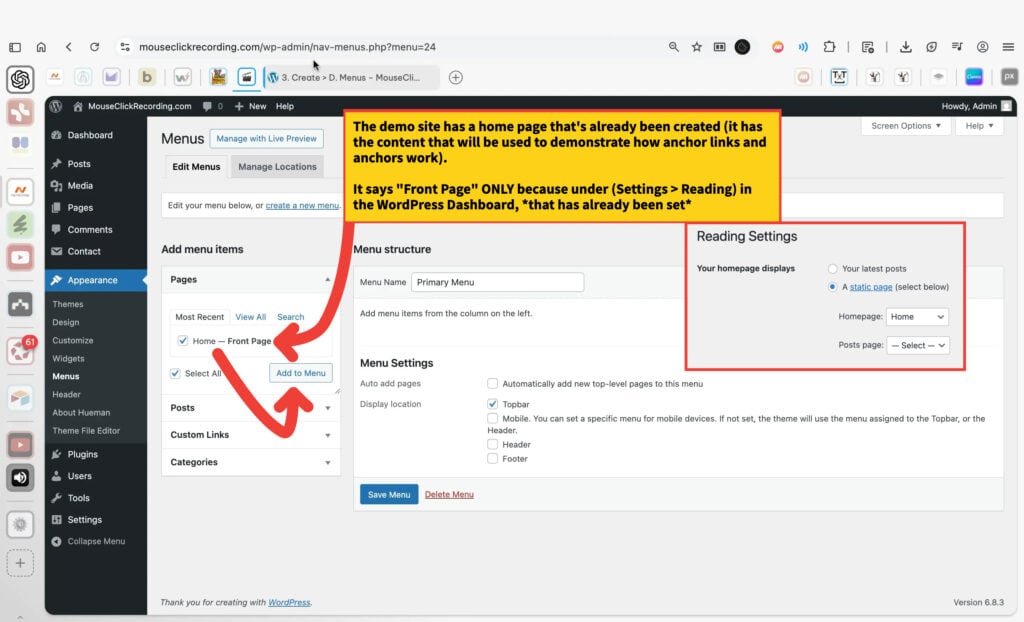
Every WordPress menu is built by choosing items from the left panel and adding them into the menu structure on the right.
In this example, the demo site’s Home page is being used simply because it already exists and contains the placeholder content needed later in the tutorial.

WordPress labels that page as the Front Page because, in the demo site’s Dashboard under Settings → Reading, the homepage setting has already been configured.
Your own site may show different labels depending on how your pages are set up.

To add a page to your menu:

  1. In the Pages section, check the box next to the page you want to include.

  2. Click Add to Menu.
    WordPress will place that page into the menu structure on the right.

6 of #
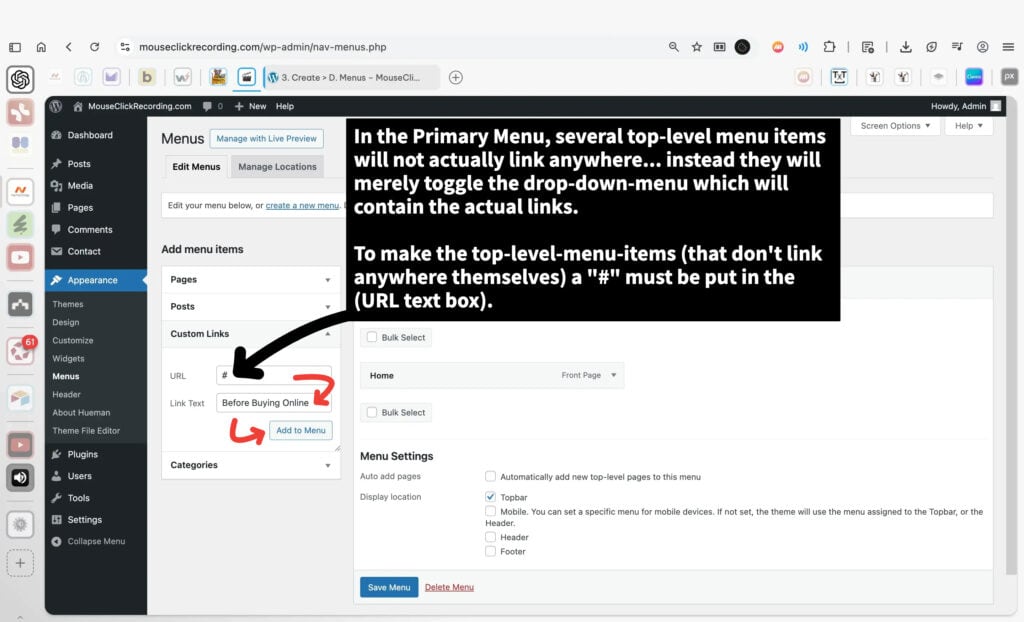
Create a Top-Level Menu Item That Doesn’t Link Anywhere

Some menu headers are just labels — they don’t go anywhere. Their only job is to open a dropdown that contains the real links.

To make a top-level menu item that doesn’t actually go anywhere, use a Custom Link and put a # in the URL box.

Then type whatever text you want the menu label to say, and click Add to Menu.

That’s it. The # simply tells WordPress, “this item isn’t a real link,” so it can act as a dropdown toggle instead of sending visitors to another page.

REGARDING ANCHOR LINKS: if you append anything after the # such as #-anchor-link-here than your basically linking to an anchor (but the anchor must be set before linking to it will do anything).

7 of #
Create a Top Level Menu-Item That Contains an Anchor Link

Anchor links let visitors jump straight to a specific section on a page or post. They’re used when a menu item should scroll to a section instead of opening a new location.

To create an anchor link, open Custom Links under where it says “Add menu items.”

In the URL field, type a “#” followed by the anchor name (for example, #contact).

Add the link text, add it to the menu, and save your changes.

If the anchor is a site-wide anchor

If the anchor is part of a section that appears on every page or post (such as a header or footer element), its ok to use the simple #contact format—no full URL needed.

If the anchor exists on a specific page or post, include its full URL before the anchor like this:

https://mouseclickrecording.com/home/#contact

8 of #
Add Selected Posts to Your Menu

Scroll through the list of posts on the left side of the Menus screen and check the boxes for the ones you want included.

After selecting everything you need, click Add to Menu at the bottom of the list.

If the list is long, keep scrolling until you reach the button.

9 of #
Reorder and Nest Menu Items

When you add new items to a WordPress menu, they always appear at the bottom of the list.

To reorder a menu item:

  • Click and hold the item.

  • Drag it up or down to the position you want.

  • Release it to place it there.

To create a sub-menu item:

  • Drag the item slightly to the right under the top-level item it belongs to.

  • When it’s indented, release it — the indentation means it’s now nested under that section.

You’ll use this same drag-and-drop action for every part of the menu you build, no matter how many top-level or nested items your site ends up having.

10 of #
How Menu Items Behave (Pages, Posts, and Custom Links)

There are different types of menu items in WordPress (pages, posts, custom links, and categories).

Pages and posts are added by selecting them and clicking Add to Menu. They appear at the bottom first, and you can drag them wherever they belong or nest them under a top-level item.

Custom Links change behavior based on what you put into the URL box:

  • A lone #
    Creates a top-level label that goes nowhere.
    It’s useful when the item is meant to open a dropdown rather than act as a clickable link.

  • An anchor link like #contact
    Scrolls the visitor to a specific section on the same page, as long as that page contains a matching anchor.
    If that anchor doesn’t exist, nothing happens.

  • A full URL plus an anchor, such as https://example.com/#contact
    Works in two steps:

    1. First, it loads the specific page or post you linked to.

    2. Then it scrolls directly to the anchor on that page (if that anchor exists).

This makes Custom Links flexible:
you can create dropdown labels, same-page scroll links, or links that jump to a specific section on another page—all from the same menu screen.

Understanding these behaviors makes it much easier to organize a menu that mixes top-level sections, dropdowns, normal links, and anchor links.

Why aren’t categories being linked to?

Categories aren’t being used as menu links because they default to “blog-style” archive pages. A category archive simply lists every post in that category—either endlessly scrolling or using older/newer post buttons.

Mouse Click Tutorials uses a more intentional, website-style structure, not a traditional blog feed. Since the demo site mirrors that structure, linking visitors to raw category archives wouldn’t match the design, flow, or experience this site is built for.

If you wanted to link directly to a category, it would be done by checking the box of a category you want to add to the menu, and clicking “Add to Menu” (which is the the same super simple method used to add pages and posts to a menu).

11 of #
Why the Menus Look Different on This Demo Site

Menu dropdowns can look different depending on the theme or menu system a site uses.

On MouseClickTutorials.com, the menus are custom-built with Bricks Builder.

The lettered items open their individual tutorial posts. The “More in ___” items open a custom post for that part of the course (like Setup or Create). Inside that post, all the content for that course area is organized into easy-to-browse sections (tutorials, reviews, interviews, etc.). This keeps everything simple and avoids dumping visitors into one long, hard-to-scroll blog feed.

On this demo site (MouseClickRecording.com), the menu uses the normal menu system that comes with the Hueman theme.

Hueman shows all dropdown items in one left-aligned list. The links still take you to the same places, but the look and layout of the dropdown comes from the theme instead of a custom Bricks-built menu.

12 of #
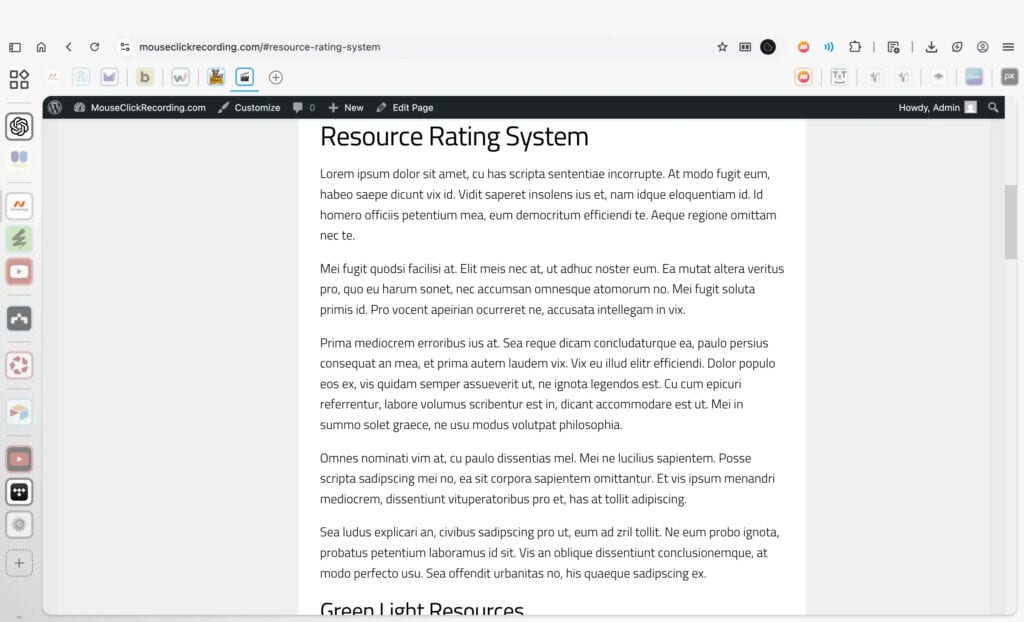
Start Adding an Anchor inside the Classic Editor

Before adding an anchor, highlight the exact text you want the visitor to scroll to. After selecting it, switch to the Code tab so the anchor can be placed in the correct spot inside the HTML. When you finish adding the anchor, make sure to update or publish the page or post.

An anchor is simply a named spot inside a page or post. The browser scrolls to that spot only when two things match:

  • the anchor placed in the page or post

  • the link that uses the same name (like #resource-rating-system)

When a link uses only a # plus the anchor name, the browser tries to scroll on the page or post the visitor is already viewing. That only works if the anchor actually exists on that specific page or post. If the anchor isn’t there, the link won’t scroll at all.

Anchors placed inside the content of one page or post will only work on that page or post. Anchors placed in a part of the site layout that appears everywhere—such as a repeating footer—will work across all pages or posts that use that layout.

The browser always follows this sequence:

  1. Load the correct page or post.

  2. Look for the anchor name.

  3. Scroll to it if it exists on that page or post.

Knowing where the anchor actually lives prevents confusion later, especially when anchor links appear in the site’s navigation menu.

13 of #
Add the Anchor ID Inside the Heading Tag

In the Code view, locate the heading for Resource Rating System. You’re going to add the anchor by giving that heading an id.

Find the opening <h2> tag for that heading and type:

id="resource-rating-system"

directly inside the tag, right after h2 and before any other attributes.

For example, if the tag started as:

<h2 style="text-align: left;">

you’ll change it so it begins as:

<h2 id="resource-rating-system" style="text-align: left;">

This does not change how the heading looks on the page or post. It just gives that spot a name the browser can scroll to.

Any link that uses #resource-rating-system will now:

  1. Load the correct page or post, and

  2. Scroll down to this heading (because it has the matching id).

If the id isn’t present on a page or post, the anchor link won’t scroll there. If the id is added inside a layout area that repeats everywhere (like a footer), the anchor will be available on every page or post that uses that layout.

Knowing how to add an id like this gives you full control whenever you want a menu link (or any link) to jump to a specific part of a page or post instead of just opening it at the top.

14 of #
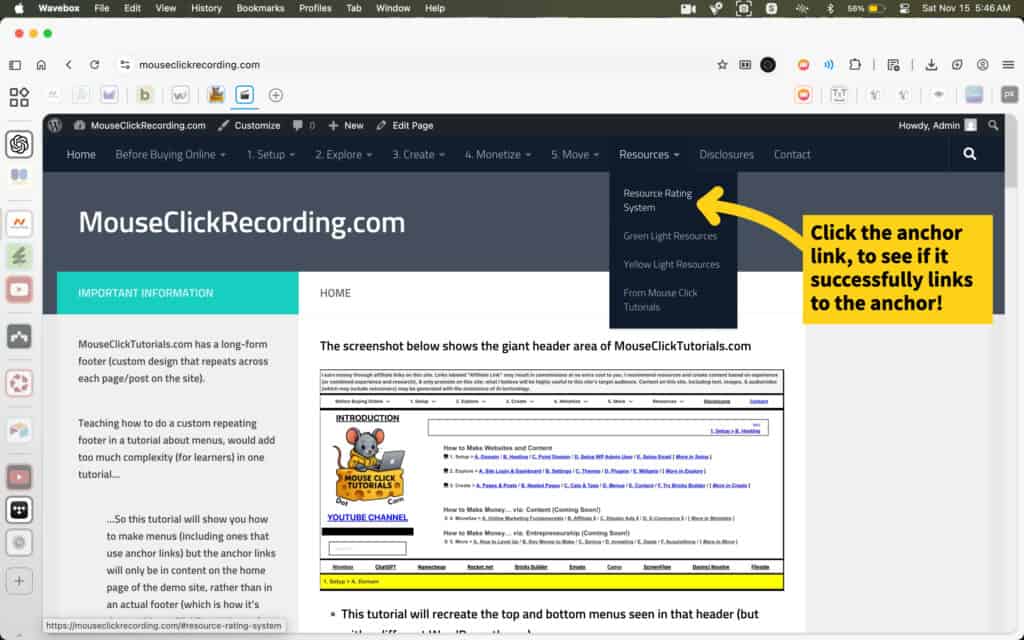
Test the Anchor Link From the Menu

After adding the anchor ID inside the heading, use the menu link to confirm that everything is working. When you click the menu item that uses #resource-rating-system, the browser should load the page or post and scroll directly to the heading with that matching ID.

If the browser does not scroll, that means the anchor ID is not present on the page or post you’re currently viewing. Anchors only work when both pieces are in place:

  1. The page or post contains the ID you added inside the heading.

  2. The link uses the same name after the # symbol.

When those match, the browser jumps to the correct spot automatically. If they don’t match—or if you are on a different page or post—then clicking the link won’t scroll.

Once the scrolling works, the anchor is fully set up and the menu link is functioning correctly.

15 of #
Understanding Why the Scroll Worked and When It Will/Won’t Work Elsewhere

If clicking the menu item brought you to this heading, the browser successfully found the anchor ID and moved to it. That confirms the ID you added inside this page or post is functioning. The important thing now is understanding why it worked in this situation, and when an anchor link will or won’t work depending on how the link is written and where the anchor lives.

In this demo, the menu link uses only #anchor-name.
A link written this way tells the browser to scroll on the page or post the visitor is already viewing.
It does not tell the browser to switch pages.

Because the anchor ID in this demo was added inside the Home page, the scroll works only when the link is clicked while already on the Home page. The ID is there, so the browser can move to it. If this same menu link were clicked from any other page or post, there would be no scroll at all, because the anchor ID simply does not exist in those locations.

Real sites usually want anchors to work from anywhere, not only from a single page. That’s done in one of two ways:

  • Using the full URL before the #
    This forces the browser to load the correct page or post first, then scroll to the anchor ID.
    Example: https://example.com/page/#anchor-name

  • Placing the anchor ID in a repeating layout area
    Some themes allow IDs to be added in global sections like footers.
    Many page builders also provide simple “anchor” or “ID” tools that can be placed in templates that appear everywhere.
    If the anchor ID exists in a site-wide layout, the simple #anchor-name version works everywhere because the anchor is present on every page or post that uses that layout.

The key idea is this:
A scroll only works when the anchor ID exists inside the page or post the visitor is currently on.
If the anchor is only on one page, the browser must be told to load that page first (by using the full URL).
If the anchor is in a layout that appears everywhere, a simple #anchor-name will work universally.

This is why the anchor scroll works in the demo, and also why a real-world site might handle things differently depending on where the anchor is placed and how it’s linked to.

16 of #
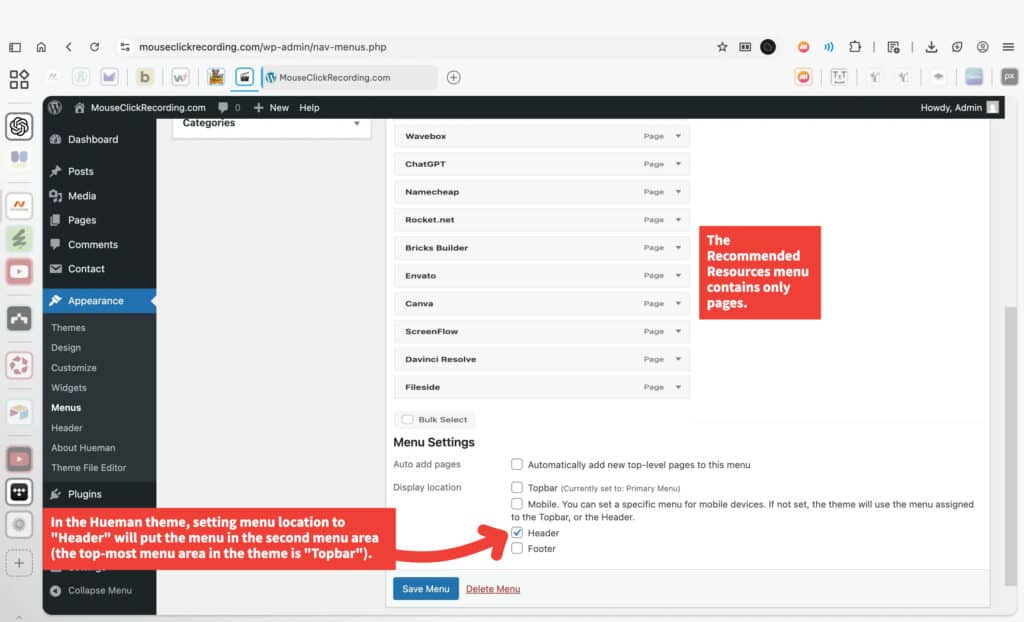
Set the Recommended Resources Menu to the Header Menu Location

Choose Header as the menu location.

In WordPress, the header is the entire top section of your site — the area visitors see before scrolling. Many themes only have one menu spot up there, but the Hueman theme has two different menu locations inside the header.

The first one (the top-most row) is called Topbar.
The second one (the main navigation row) is called Header.

This is where beginners often get confused: both menu locations are technically “in the header,” but they are not the same place.

Selecting Header puts the Recommended Resources menu in the main navigation row beneath the Topbar, not in the top-most bar.

This keeps the layout clear and shows the menu where visitors naturally expect it.

17 of #
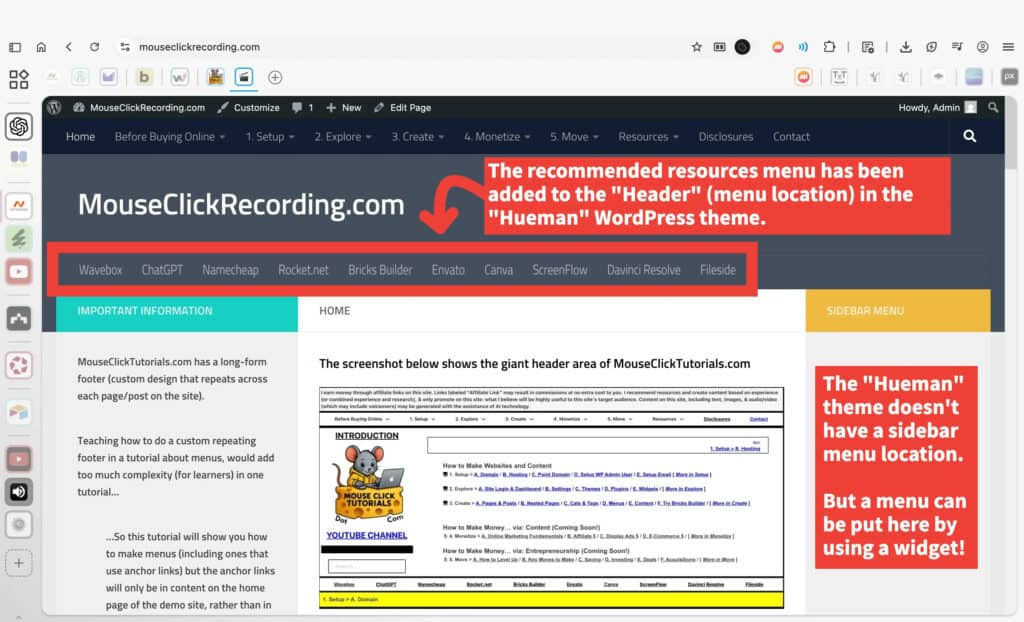
Add the Recommended Resources Menu to the Hueman Theme

Assign your Recommended Resources menu to the Header menu location in the Hueman theme. This places your resource links directly beneath the main navigation, keeping them visible across all pages and matching the layout used on MouseClickTutorials.com.

The Hueman theme does not offer a built-in Sidebar Menu location.
If you want a menu in the sidebar, you can still create one by adding a Navigation Menu widget to a sidebar widget area. This lets you display a custom menu in the sidebar even though the theme doesn’t include that position by default.

18 of #
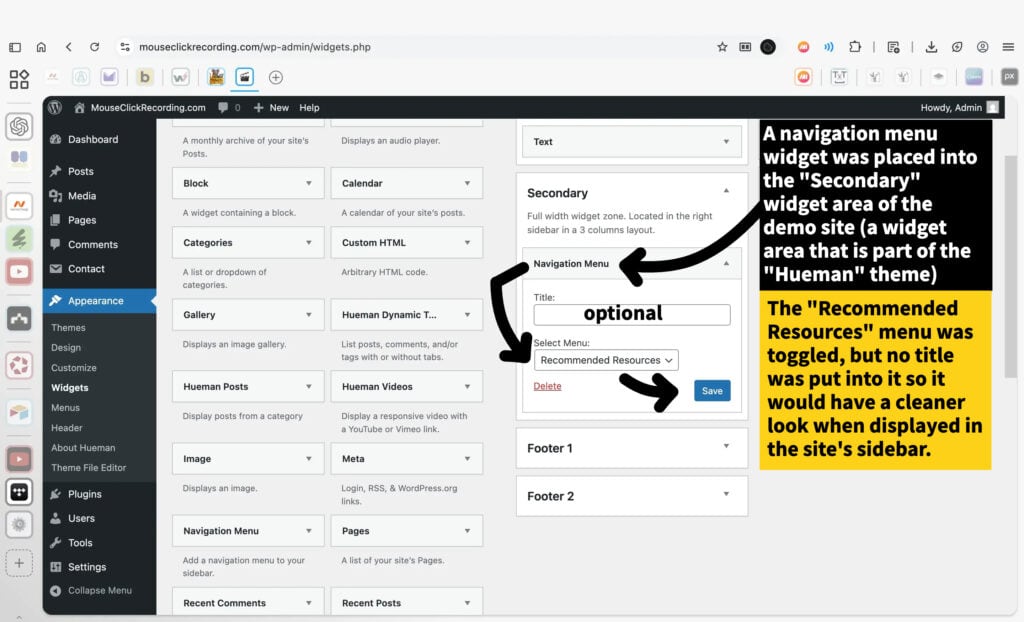
Add the Recommended Resources Menu to the Sidebar (Using a Widget)

In the Widgets screen, add a Navigation Menu widget to the Secondary widget area. This area is part of the Hueman theme and controls the right-hand sidebar on the demo site.

From the dropdown, choose your Recommended Resources menu.
The Title field is optional — leaving it blank gives the sidebar a cleaner look, since only the menu items will appear.

Click Save to finish adding the menu to the sidebar.

19 of #
View the Recommended Resources Menu in the Sidebar

After adding the Navigation Menu widget in the previous step, the Recommended Resources menu now appears in the site’s sidebar. This is because the widget was placed in the Secondary widget area, which controls the sidebar layout in the Hueman theme.

Each item from your Recommended Resources menu is now listed in the sidebar, giving the demo site a clean, organized way to display those links throughout the page.

MouseClickTutorials.com

Teaching people how to make websites...
...and how to make websites make money!

Before You Buy: Know the Industry Games

Hidden Incentives in Online Recommendations

A lot of content online looks like it’s meant to be helpful. It might be labeled as a review, a list of top picks, or just a casual post like “I found this and it’s cool.” But in many cases, that content isn’t created to help someone make a better decision. It’s created to earn money through affiliate commissions.

What affiliate links are for

Affiliate links exist to support content by allowing someone to earn a commission when a product or service is purchased through a link they’ve shared. That’s the whole purpose. It doesn’t add cost to the buyer—and when used responsibly, it can reward content that genuinely helps.

The problem is how these links influence what gets recommended in the first place.

How incentives distort content

Some affiliate content is shaped by payouts—where higher-paying products and services get pushed harder. But more often, the problem is something else entirely: laziness.

A lot of affiliate content isn’t the result of research or thoughtful guidance. It’s based on whatever’s convenient. A product or service is already popular, someone else is promoting it, or it has an affiliate program—so it gets plugged in without much thought. There’s no testing, no real consideration of what would actually help the audience, and no accountability.

In these cases, the product or service itself might be perfectly fine. But the recommendation isn’t grounded in anything useful, and that’s what creates the disconnect. It leads to content that promotes whatever’s easiest to monetize, skips stronger alternatives that require more effort to discover, avoids mentioning downsides that could reduce clicks, and simply recycles whatever’s already trending among other affiliates.

It’s not about how much something pays. It’s about why it’s being recommended.

A product or service that pays well isn’t the problem if it actually fits the use case. But when it’s included just because it earns—or because it was the easiest thing to grab—that’s not a real recommendation. It’s content that exists to sell, not to help.

How to recognize honest affiliate content

Genuine recommendations feel different. Affiliate links are disclosed openly. Pros and cons are explained clearly, not glossed over. The explanation comes before the link. Alternatives that don’t offer commissions are still mentioned when they’re relevant. And the content doesn’t rely on pressure, urgency, or sales language to get someone to click.

When an affiliate link supports a thoughtful recommendation, it adds value. When the link is the reason something was included in the first place, the integrity of the content falls apart.

How this site handles it

Affiliate links are used here—but never as the reason something gets recommended. Some products and services pay nothing. Others pay less than their competitors. If they actually work, solve a real problem, and serve the audience this site is built for, they get included.

Payouts don’t determine what’s shown. Usefulness, reliability, and fit for the audience do.

Every recommendation on this site includes two links side by side: a clearly marked affiliate link, and a non-affiliate version. That way, anyone who wants to support the site can do so with one click—without being forced into it. And anyone who doesn’t can still access the same product or service without friction.

No popups, no fake scarcity, and no pressure. Just clear information and real options — presented with your time and trust in mind.

How to Choose Web Hosting That Won’t Screw You Later

Why Hosting Choices Can Look Fine at First — and Still Cost You Later

Many web hosting recommendations are influenced by affiliate incentives. That influence often shapes what gets promoted — not based on what’s reliable or useful, but based on what earns commissions. To understand how that works, scroll up to Hidden Incentives in Online Recommendations.

Once that’s clear, it becomes easier to recognize common patterns in how web hosting is sold — especially when it comes to pricing, positioning, and long-term reliability.

What Is Web Hosting, Really?

Web hosting is infrastructure. It’s what keeps a website live, accessible, and functioning smoothly. It stores the site’s files, manages uptime and speed, and often determines how frustrating things get when something breaks.

A good host does its job in the background — quietly, reliably.
A bad host appears fine at first — then slowly drags performance down through downtime, slowness, or support failures.

And often, that decline is masked early on by extra-friendly onboarding.
Sales chat is responsive. Setup support feels hands-on. It’s all about getting the account active and the site online fast. But after that grace period — often right after the refund window passes — service quality shifts.

Some companies do this deliberately: prioritize new customers, while gradually neglecting existing ones.
Others just aren’t equipped to deliver consistent support at scale. Either way, the pattern is common — especially with shared hosting.

Why Shared Hosting Gets Promoted So Heavily

Shared hosting is one of the most promoted types of hosting — not because it’s reliable, but because it’s easy to sell and easy to profit from. Many hosting companies offer shared plans as a low-cost entry point. And many of those companies run affiliate programs where commissions are paid out just for generating a new customer — regardless of which plan the customer signs up for.

That means affiliates often push the cheapest plan available, because it’s easier to convert — even though the payout is the same (or nearly the same) as recommending a better option. A $2.99/month shared hosting plan can still result in a $100+ commission, because the hosting company expects that customer to stick around long enough to cover the cost.

This dynamic is why shared hosting dominates most “best web host” lists — not because it’s actually good, but because it converts easily and pays well.

Why This Site Rejects Shared Hosting Entirely

MouseClickTutorials.com does not recommend shared hosting under any circumstances — not for beginners, not for temporary projects, not for anyone.

Even when managed by capable companies, shared hosting remains too unstable, too crowded, and too limited to serve as reliable infrastructure. It introduces risks and headaches that are completely avoidable with better hosting types. The environment is unpredictable, the performance is inconsistent, and the support is often too generic to be helpful when something goes wrong.

This position isn’t based on theory — it’s based on what actually happens when shared servers are overloaded, misconfigured, or mismanaged. And even without bad intent, it’s incredibly easy for problems to creep in unnoticed. One site’s spike in traffic or bad code can affect everyone else on the server.

Shared hosting is one of the biggest reasons new site owners feel like they “did something wrong,” when the real issue is invisible under the hood. That’s not a foundation worth building on.

The Issue with “Free” Domains

Many hosting companies advertise a “free domain” when signing up for a plan. But in most cases, the domain offer includes conditions:

  • The domain may be registered in the host’s name rather than the customer’s.

  • It may be locked or tied to the hosting plan, making it difficult or expensive to transfer.

  • The domain becomes the anchor keeping people on subpar hosting just to keep their site online.

    The fix: always register domains separately with a trusted registrar like Namecheap. That ensures full ownership and makes it easy to change hosts at any time.

Why Cheap Hosting Isn’t Really Cheap

Low introductory prices like $2.99/month are usually misleading:

  • Most require paying 2–3 years upfront to get that rate

  • Renewal rates after the initial term are much higher

  • Core features like backups, SSL, and live support may cost extra — or be limited

  • “Unlimited” plans often include vague usage caps that throttle performance as sites grow

What seems cheap upfront becomes expensive over time — in stress, in missed revenue, and in wasted hours troubleshooting problems that wouldn’t exist on better infrastructure.

And that’s not just a figure of speech. If a site owner spends 40+ hours a year dealing with slow load times, broken features, unclear issues, and back-and-forths with bad support — and if that person would be paid even minimum wage for that time — the true cost of “cheap” hosting becomes obvious.

The value of reliable hosting isn’t just technical. It’s economic. It protects time, momentum, and peace of mind.

Understanding Hosting Types — and Why This Site Only Recommends Some

There’s no universal “best,” but some types of hosting are far better suited for actual website owners — and some should be avoided entirely. Here’s a breakdown:

Shared Hosting
Low-cost, low-quality. Unpredictable performance. Limited scalability.
Often oversold and oversaturated. Even beginners should avoid it.

Managed WordPress Hosting
Built specifically for WordPress. Handles caching, updates, backups, and security automatically.
Fast, secure, and low-maintenance — ideal for most creators, freelancers, and business owners.
This is the default recommendation for a reason.

VPS Hosting (Virtual Private Server)
A private slice of a physical server. More control and flexibility, but also more responsibility.
Best for those with technical experience or specific configuration needs.

Cloud Hosting
Highly scalable and fast — if fully managed. If unmanaged, it can become overly complex.
Great for ecommerce, SaaS, or platforms expecting rapid growth, as long as the host handles the technical side.

Dedicated Hosting
An entire server for one user. Very powerful, very expensive.
Best reserved for advanced use cases with high traffic or strict infrastructure needs.

Colocation
The highest tier — full control over physical hardware inside a rented datacenter rack.
Used for enterprise infrastructure, compliance requirements, or custom network architecture.
Not relevant for most site owners.

What Actually Makes Sense for Most People

For most websites — especially anything built on WordPress — managed WordPress hosting strikes the right balance. It’s fast, secure, and far easier to manage than alternatives that require technical upkeep.

There are more powerful hosting options for those running complex infrastructure or custom apps, but managed WordPress hosting covers the needs of most creators, freelancers, small businesses, and growing projects — without the stress.

The best managed hosts don’t just check boxes. They eliminate problems before they happen.
They don’t disappear when support is needed. They don’t nickel-and-dime for features.
They just make the site work — and keep it working.

That’s the experience most people are actually looking for. And that’s the experience this site teaches people how to build toward.


????

Hosting Types, Use Cases, and a Reliable Default

Why Your Host Isn’t Just a Checkbox — and What Actually Works for Most People

Most people picking web hosting treat it like a quick checkbox.
Domain, check. Hosting, check. Done.

But your hosting provider determines how fast your site loads, how often it breaks, how secure it stays, and how painful things get when something goes wrong.

It’s infrastructure — not a formality.
And one type of hosting still gets pushed far too often — especially by affiliate blogs chasing easy commissions.

Shared Hosting

This is where MouseClickTutorials.com draws a hard line.

Shared hosting is the $2.99/month pitch that sounds beginner-friendly… but quietly causes more damage than most new site owners can spot. Your site gets dropped into a crowded server with hundreds or thousands of others, all fighting for the same limited resources.

If another site spikes in traffic or runs unstable code, your site slows down — or goes down.
Support is slow, vague, and scripted.
Problems get blamed on you, with upgrade nudges as the default fix.

It often looks fine at first. That’s the problem.
When your site slows down or glitches later, you assume it’s something you did wrong.

But it’s not. It’s the hosting.
This site does not recommend shared hosting. Not for beginners. Not for anyone. Not ever.

Managed WordPress Hosting
This is the recommended path for most people building on WordPress.

Managed WordPress hosting is built to remove technical headaches. It handles backups, caching, updates, and security automatically — so you don’t need extra plugins just to keep things stable. The best providers offer fast performance and platform-aware support teams who actually know WordPress.

It’s low-maintenance. High-reliability.
And it’s the default recommendation here because it actually works.

VPS Hosting
A virtual private server (VPS) gives you more control and power — but also more technical responsibility.

You manage server setup, patches, security, and updates.
It’s great for developers and experienced users.
It’s not ideal for beginners or creators who want to focus on building content, not managing infrastructure.

Cloud Hosting
Cloud hosting can be powerful, scalable, and efficient — if it’s fully managed.

Otherwise, it comes with complexity most people don’t want.
Server configuration, cost optimization, scaling logic — it’s easy to get lost in the weeds unless the platform handles those pieces for you.

Used well, cloud hosting is a strong choice for fast-growing platforms, ecommerce sites, or custom apps. But for a first site or general-purpose WordPress site, it’s often overkill.

Dedicated Hosting
Dedicated hosting gives you your own physical server — with total control and no resource sharing.

It’s powerful and expensive, and usually reserved for specialized use cases: high-traffic apps, large media platforms, or advanced infrastructure stacks.
It’s not the place to start unless you already know exactly why you need it.

The Reliable Default

For most people using WordPress — creators, freelancers, educators, business owners — managed WordPress hosting is the most useful path forward.

It’s fast. It’s secure. It scales without stress.
And it keeps your site online, protected, and supported — without you needing to touch the backend.

That’s what this site recommends.
That’s what this site teaches.
Because it actually works.

Why Rocket.net is Recommended for Managed WordPress Hosting

1. Specialized WordPress Hosting: Why Rocket.net is a Perfect Fit

Rocket.net focuses exclusively on hosting WordPress websites. This specialization ensures their servers and services are optimized to deliver the best performance, security, and user experience for WordPress users. If you’re building a WordPress site, Rocket.net provides a tailored environment designed specifically for your needs.

2. Blazing Fast Performance: Why Rocket.net Prioritizes Speed

With advanced caching, a content delivery network (CDN) included in every plan, and servers fine-tuned for WordPress, Rocket.net ensures your site loads quickly for users around the globe. Fast websites improve user experience and can help boost search engine rankings.

3. Comprehensive Security: Why Rocket.net Protects Your Site

Rocket.net provides built-in security features like firewalls, malware scanning, and protection against DDoS attacks. Their proactive approach ensures your website stays safe and your data remains secure without needing additional plugins or services.

4. Hassle-Free Management: Why Rocket.net is Easy to Use

Rocket.net simplifies WordPress hosting with automatic updates, a clean and intuitive control panel, and one-click WordPress installations. Their beginner-friendly interface and expert support make managing your hosting stress-free, even if you’re new to websites.

Rocket.net is a premium WordPress hosting provider that specializes in delivering fast, secure, and user-friendly hosting services. With optimized performance, built-in security, and dedicated WordPress support, Rocket.net is a top choice for anyone looking to create and maintain a high-performing WordPress site.

Check out the complete setup tutorial here →

Regular Link

I don't earn commissions from this link

Affiliate Link

I earn commissions from this link

When Managed Hosting Isn’t Enough

Other Hosts to Consider

Rocket.net is the recommended starting point for most users — it’s fast, secure, and built specifically for WordPress. It handles speed, stability, and security without overwhelming you with backend tasks.

But if you’re building something more complex, running multiple applications, or just want to understand what else is out there, here are a few other hosts worth knowing about.

These hosts are grouped by how much control and infrastructure complexity they offer — starting with other options in the same managed WordPress category, then expanding into VPS, full-stack platforms, and finally, enterprise-level hosting.

Managed WordPress (Same Tier, Different Strength)

Templ.io
Templ.io is another managed WordPress host — in the same category as Rocket.net. While Rocket.net is the top recommendation here, Templ.io stands out for one reason: their support team is more willing to assist with technical issues at the code level.

If a plugin breaks layout or a script throws an error, they may help you investigate what’s going wrong. They won’t write your code, but they’ll go deeper than most.
Use if you want managed WordPress hosting with an extra layer of technical support — without leaving the simplicity of this hosting tier.

Managed VPS (More control, broader use cases)

KnownHost
KnownHost gives you full server-level access through managed VPS hosting. You can install custom software, run multiple apps, configure email, and handle more advanced workflows than a WordPress-only host would allow.

Some plans still use cPanel, while others may include DirectAdmin — check the specifics before choosing.

Use if you’re managing more than just a WordPress site, or need flexibility that managed WordPress doesn’t offer.

Managed VPS (cPanel-focused, long-term scalability)

Hivelocity
Hivelocity offers managed VPS hosting with strong cPanel support, full root access, and upgrade paths into dedicated servers or colocation — all without locking you into a proprietary dashboard.

You’re not limited to WordPress, and you don’t need to give up traditional tools.

Use if you want a cPanel-friendly platform with the freedom to run mixed environments — and the ability to scale far beyond VPS later if needed.

Cloud-Native Performance Hosting

Servebolt
Servebolt doesn’t follow the VPS/cPanel playbook. It’s built from the ground up for speed — especially for dynamic sites like WordPress or WooCommerce.

They manage performance at the stack level: memory allocation, rendering optimization, backend tuning — all handled by their proprietary infrastructure.

Use if you’re running a high-traffic or ecommerce-heavy site where raw speed is a top priority and you’re okay with skipping traditional server tools.

Dedicated Servers (Unmanaged, full control)

Hetzner
Hetzner is known for high performance at extremely competitive prices — especially in the EU. They offer both dedicated hardware and cloud instances, but everything is self-managed. No hand-holding, no support for setup or configuration.

It’s powerful, but entirely your responsibility.

Use if you know what you’re doing and want total ownership of your environment for speed, scale, or regulatory control.

Colocation (Enterprise-grade physical infrastructure)

Colocation Providers
Colocation means you own the hardware. You rent rack space in a datacenter — they supply power, cooling, and bandwidth, but everything else is up to you.

This isn’t a web hosting plan — it’s raw infrastructure.

Used by SaaS companies, media platforms, and organizations with strict compliance, latency, or scaling needs.

Providers in this space include Hivelocity, PhoenixNAP, Equinix, Digital Realty, ColoCrossing, and OVHcloud.

Use if you already know exactly why you need this. If you’re not sure, you don’t.

Recommended Resources - Review Process

Traffic Light Rating System: Overview

Recommended resources are rated using a system inspired by traffic lights. This system makes it easier to find what’s actually useful for building websites, streamlining workflows, and boosting productivity across different areas. Resources are evaluated for their quality, reliability, and how much they benefit MouseClickTutorials’ audience.

Green Light resources are intentionally few. Very few resources are truly Green Light worthy, and from those, only a small mix is chosen. That’s deliberate — people only have so much time, energy, and money, so this tier exists to serve the best interests of MouseClickTutorials’ audience. If a resource appears here, it’s because it delivers proven value for those learning and building along with this site.

Yellow Light resources are also excellent, but not all are meant for the very top. Most wouldn’t make the cut for Green Light, though a few could. Their placement here doesn’t take away their value — it reflects the balance between curation, context, and the need to keep Green Light small and focused. Yellow Light provides more worthwhile resources that can still help this audience, without stretching the top tier too far.

Why No Red Light Resources?

There’s no “red light” category here. Low-quality or harmful resources aren’t listed at all. This approach is intentional, for a few reasons:

  • Practicality: Listing every bad product or service would flood the site with noise and make it harder to spot what’s actually valuable.

  • Liability: Calling out poor options by name risks legal issues like defamation. Focusing on trusted recommendations avoids that problem.

  • Awareness: In other parts of the site, industries like web hosting and affiliate marketing are explained in depth — so readers learn how to avoid pitfalls and spot shady practices without needing a blacklist.

Green Light Resources

Wavebox

Wavebox

Wavebox is a unified browser-workspace platform designed to streamline how people manage apps, tabs, and daily workflows. Instead of juggling dozens of windows or losing track of important tools, Wavebox brings everything together in a structured, distraction-reducing environment. Its Chromium foundation ensures full compatibility with modern web apps, while its workspace organization, app containers, and sleep-mode optimizations keep performance smooth even with heavy multitasking. Whether handling email, project dashboards, creative tools, or research tabs, Wavebox creates a stable hub that simplifies digital work and reduces friction throughout the day.

Beyond organization, Wavebox includes powerful features such as memory isolation, multi-account separation, customizable workflows, and deep integrations with AI and automation tools. These capabilities help users maintain focus, switch contexts without clutter, and move through tasks with more efficiency and clarity. Built-in features like split-screen views, tab sets, and smart search reinforce Wavebox’s role as a consolidated command center rather than a standard browser. With continuous improvements and a design centered on productivity, Wavebox has become a preferred choice for creators and professionals who want a faster, more controlled way to manage complex digital environments.

Wavebox

Internal Review (Learn More)
Regular Link

Commissions will not be earned from this link.

*Not Monetized

Affiliate Link

Commissions may be earned from this link.

*Monetized

ChatGPT

ChatGPT

ChatGPT is a powerful AI platform built to enhance creativity, clarity, and problem-solving across a wide range of real-world tasks. It isn’t a basic content generator; it functions as an adaptive thinking partner capable of understanding context, analyzing information, and producing high-quality outputs that support user goals. The interface is built for speed and precision, making it easy to draft content, refine ideas, interpret instructions, and break down complex topics. Whether the task involves building a website, improving workflows, planning content, or mapping out next steps, ChatGPT offers a focused environment that elevates both creative and technical work.

Beyond writing support, ChatGPT includes advanced multimodal abilities such as image understanding, image editing, troubleshooting guidance, data interpretation, and step-by-step reasoning. This allows it to assist with everything from diagnosing technical issues to shaping strategies and improving decisions. Its ability to shift between creative insight, analytical depth, and practical instruction sets it apart from single-purpose tools. Combined with continuous updates and a design centered on usability, ChatGPT serves as a reliable partner for anyone looking to work smarter, speed up production, and navigate complex problems with confidence.

ChatGPT

Internal Review (Learn More)
Regular Link

Commissions will not be earned from this link.

*Not Monetized

Affiliate Link

Commissions may be earned from this link.

*Monetized

Namecheap

Namecheap

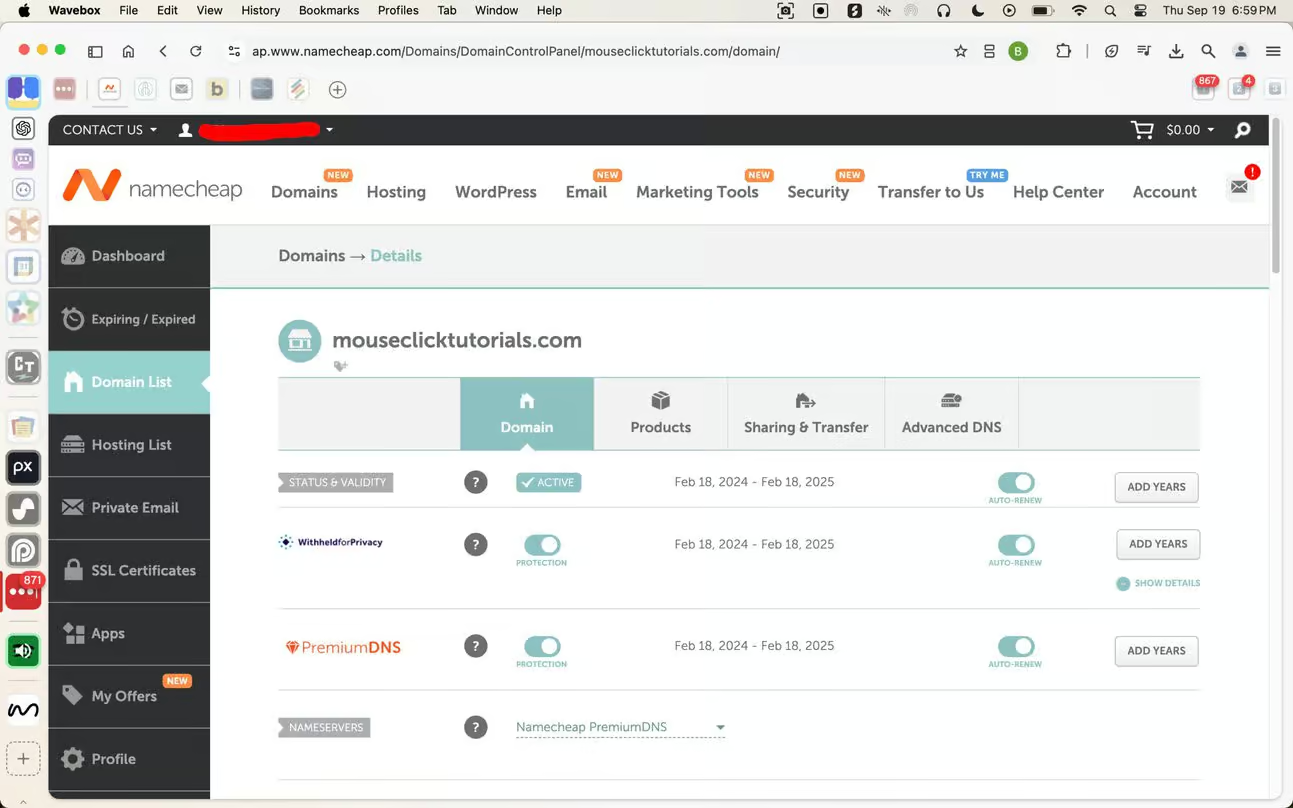
Namecheap is an ICANN-accredited domain registrar that offers a wide range of services dedicated to securing online identities for both individuals and businesses. With a strong reputation for affordable pricing, Namecheap allows users to register their domains without hidden fees, making it an attractive option for many. Its platform is designed with user-friendliness in mind, providing intuitive management tools that enable customers to easily manage their domains and associated services. Whether you’re a startup looking to establish your brand or an individual wanting a personal website, Namecheap caters to a variety of needs while emphasizing full ownership and control over the domain.

In addition to domain registration, Namecheap also provides various ancillary services, such as hosting options, SSL certificates, and website builders, allowing users to create a complete online presence from one platform. Their commitment to customer support is reflected in their responsive help desk, which assists users with any queries or issues they may encounter. This combination of reliable service, valuable features, and a focus on user empowerment has solidified Namecheap’s position as a premier choice for anyone looking to build and maintain a robust online identity, ensuring that customers can confidently navigate the complexities of establishing a website in today’s digital landscape.

Namecheap

Internal Review (Learn More)
Regular Link

Commissions will not be earned from this link.

*Not Monetized

Affiliate Link

Commissions may be earned from this link.

*Monetized

Rocket.net

Rocket.net

Rocket.net is a premium managed WordPress hosting platform engineered for exceptional speed, reliability, and security right out of the box. Unlike traditional hosts that require extensive configuration to reach peak performance, Rocket.net optimizes everything at the edge, delivering ultra-fast load times through its global CDN, built-in caching, and enterprise-grade infrastructure. The platform is designed with creators and businesses in mind, offering a clean, intuitive dashboard that makes it easy to deploy, manage, and maintain WordPress sites without technical friction. Whether you’re launching a personal project or scaling a high-traffic brand, Rocket.net provides an environment that prioritizes both performance and simplicity.

In addition to speed, Rocket.net emphasizes security and stability, integrating automatic backups, WAF protection, malware prevention, and daily updates to ensure your site stays safe and running smoothly. Their support team—known for rapid, expert-level assistance—helps users resolve issues quickly and confidently, reinforcing Rocket.net’s reputation as a premium hosting provider. Combined with its focus on transparency, hands-off optimization, and consistently strong uptime, Rocket.net has become a preferred choice for those who want a powerful, worry-free hosting experience. Its performance-first ecosystem enables creators to focus on building content and growing their audience while the platform handles the technical heavy lifting behind the scenes.

Rocket.net

Internal Review (Learn More)
Regular Link

Commissions will not be earned from this link.

*Not Monetized

Affiliate Link

Commissions may be earned from this link.

*Monetized

Bricks Builder

Bricks Builder

Bricks Builder is a highly flexible visual website builder for WordPress that empowers creators to design fast, modern, and fully responsive sites without relying on bloated themes or complex coding. Known for its clean interface and precision control, Bricks gives users the ability to build everything—from simple landing pages to full-scale dynamic websites—using an intuitive structure panel and real-time editing environment. Its performance-first approach ensures that sites load quickly and rank well, making it a strong choice for both beginners who want clarity and professionals who want depth. With global classes, reusable templates, and fine-grained layout controls, Bricks places real design freedom directly in the user’s hands.

Beyond page building, Bricks includes advanced features typically found only in premium add-ons, such as a native template system, dynamic data integration, theme-builder capabilities, and conditional logic. This allows you to visually create headers, footers, archives, single posts, and even WooCommerce layouts from a single unified tool. Its active development cycle and helpful community also ensure that users receive ongoing improvements, transparent communication, and practical support. Altogether, Bricks Builder stands out as a powerful all-in-one solution for anyone looking to build a polished, high-performance WordPress website with full creative control—streamlining the process while keeping the technical foundation solid and future-ready.

Bricks Builder

Internal Review (Learn More)
Regular Link

Commissions will not be earned from this link.

*Not Monetized

Affiliate Link

Commissions may be earned from this link.

*Monetized

Envato

Envato

Envato is a comprehensive creative marketplace designed to provide high-quality digital assets for building websites, videos, brands, and online content. Instead of sourcing graphics, templates, plugins, or stock media from scattered platforms, Envato consolidates everything into a single, well-organized ecosystem. Its library includes WordPress themes, design templates, stock photos, music, motion graphics, and more—making it a reliable resource for creators who want polished, professional assets without spending hours searching. With clear licensing and easy downloads, Envato supports both rapid production and long-term project needs across a wide range of creative fields.

Beyond its marketplace, Envato offers subscription-based access through Envato Elements, unlocking unlimited downloads for those who produce content at scale. This includes templates for websites, presentations, social media, and video editing tools—ideal for anyone building a digital presence or producing regular tutorials. Combined with strong search features, curated collections, and continuous library updates, Envato has become a go-to solution for creators who value quality, efficiency, and consistency. Its emphasis on accessible assets and straightforward workflows makes it an essential companion for modern content production, helping projects move faster while maintaining a professional polish.

Envato

Internal Review (Learn More)
Regular Link

Commissions will not be earned from this link.

*Not Monetized

Affiliate Link

Commissions may be earned from this link.

*Monetized

Canva

Canva

Canva is an accessible design platform built to help creators produce polished visuals without the complexity of traditional graphic design software. Its drag-and-drop interface, extensive template library, and wide selection of fonts, graphics, and layout elements make it easy to create everything from social posts and thumbnails to presentations, print materials, and web graphics. Canva’s workspace focuses on speed and clarity, allowing users to move from idea to finished design quickly while maintaining a clean, professional look. Whether preparing course assets, marketing materials, or visual elements for a website, Canva provides a straightforward environment that supports both beginners and experienced designers.

Beyond basic design tools, Canva offers features such as brand kits, collaborative editing, background removal, AI-assisted generation, and an ever-expanding media library that helps streamline creative workflows. Export options accommodate a variety of formats, making it simple to integrate designs into videos, websites, or printed materials. Continuous updates and a strong template ecosystem ensure users always have fresh resources to draw from. With its blend of usability, flexibility, and creative support, Canva has become a go-to solution for anyone who needs high-quality visuals without slowing down production, enabling fast iteration and consistent design across all types of content.

Canva

Internal Review (Learn More)
Regular Link

Commissions will not be earned from this link.

*Not Monetized

Affiliate Link

Commissions may be earned from this link.

*Monetized

ScreenFlow

ScreenFlow

ScreenFlow is a streamlined screen recording and video editing platform built for creators who need clean, professional results without a complicated production pipeline. It captures screen activity, webcam, microphone, and system audio with clarity, making it ideal for software tutorials, walkthroughs, and instructional content. The interface emphasizes ease of use and precise control, allowing users to cut, annotate, highlight, and refine footage quickly. Its smooth timeline editing and built-in visual callouts help turn raw recordings into polished, viewer-friendly videos with minimal effort.

Beyond basic captures, ScreenFlow includes advanced features such as multi-layer editing, animated annotations, text effects, chroma key, and audio cleanup tools that elevate production quality. Export presets optimize videos for course platforms, YouTube, and social channels, ensuring consistent results across different publishing workflows. Stable performance and a lightweight footprint keep the editing process responsive, even for long-format tutorials. With ongoing updates and a user experience centered on speed and clarity, ScreenFlow remains a favored tool for creators who want an efficient, all-in-one solution for turning screen recordings into professional, instructional content.

ScreenFlow

Internal Review (Learn More)
Regular Link

Commissions will not be earned from this link.

*Not Monetized

Affiliate Link

Commissions may be earned from this link.

*Monetized

Davinci Resolve

Davinci Resolve

DaVinci Resolve is a comprehensive post-production platform designed for creators who want studio-level control without relying on multiple separate applications. Its unified interface brings editing, color grading, visual effects, audio engineering, and delivery together in a single workflow, allowing projects to move seamlessly through each stage of production. The editing workspace is fast and responsive, supporting precise cuts, layered timelines, and efficient assembly for everything from short-form content to long-format videos. Resolve’s color grading tools—renowned throughout the industry—enable detailed adjustments that shape the style, mood, and visual identity of any project.

Beyond editing and color, DaVinci Resolve integrates advanced modules such as Fusion for motion graphics and compositing, Fairlight for professional audio mixing, and a powerful export system tailored to every major platform. GPU acceleration keeps performance smooth even with high-resolution footage, and continual updates introduce new creative tools and workflow improvements. This all-in-one structure makes Resolve especially valuable for creators who want to keep their entire production pipeline under one roof. With its blend of power, precision, and long-term scalability, DaVinci Resolve stands out as a cornerstone tool for producing polished, high-quality video content at any level of expertise.

Davinci Resolve

Internal Review (Learn More)
Regular Link

Commissions will not be earned from this link.

*Not Monetized

Affiliate Link

Commissions may be earned from this link.

*Monetized

Fileside

Fileside

Fileside is a focused, multi-panel file manager designed to eliminate the friction of navigating complex folder structures. Instead of juggling separate windows or repeatedly drilling into nested directories, Fileside lets users build custom layouts with multiple panels visible at once, creating a clear overview of their entire workspace. This approach makes comparing folders, moving assets, and organizing project files significantly faster, especially for creators handling large volumes of media, screenshots, documents, and production resources. Its clean interface keeps everything accessible without the clutter typical of traditional file explorers.

Beyond its layout system, Fileside includes practical features such as persistent workspaces, quick folder bookmarking, panel presets, and rapid file previews that help maintain momentum during content creation and editing sessions. Drag-and-drop operations feel smooth and predictable, reducing repetitive actions and keeping workflows efficient. Stability and low overhead make it reliable even when managing sizable directories. With an emphasis on clarity, speed, and control, Fileside serves as a dependable organizational hub for creators who want a more structured way to manage digital assets and stay oriented during demanding projects.

Fileside

Internal Review (Learn More)
Regular Link

Commissions will not be earned from this link.

*Not Monetized

Affiliate Link

Commissions may be earned from this link.

*Monetized

Yellow Light Resources

A

(No entries yet)


B

(No entries yet)


C

Canva
A drag-and-drop design tool that’s simple to use and great for social graphics, thumbnails, or even pitch decks.
Visit Canva

ChatHub.gg

Designed to support multiple AI chat models in one place, this platform is particularly useful for comparing responses from different models or avoiding rate limits. Users can view up to six prompt windows simultaneously, allowing for the exploration of various models on the same screen. While only one prompt can run at a time, the ability to send a prompt and skim through responses that have already landed enables a more dynamic workflow. This feature is especially beneficial for those in a hyper workflow mode, as it helps maintain creative flow. Users can quickly switch between prompts and ideas, making it easier to iterate rapidly. Although the primary use case is for comparing responses from different AI models, the platform also supports users who thrive on taking swift action and keeping momentum in their creative processes.

Note: While ChatGPT is often the go-to choice for many, this platform serves as an excellent alternative during moments of heightened productivity.


ChatHub.gg

Classic Editor
Restores the original WordPress post editor for those who dislike Gutenberg.
Classic Editor Plugin — by WordPress Contributors

Classic Widgets
Restores the legacy drag-and-drop widget screen in WordPress. Helpful for non-block users.
Classic Widgets Plugin — by WordPress Contributors


D

Darius Foroux – Get Rid of Your High Expectations
An insightful article discussing the pitfalls of holding high expectations. Foroux shares personal experiences to illustrate how unrealistic expectations can lead to disappointment. He suggests embracing lower expectations to cultivate gratitude and reduce frustration, promoting a more content and resilient mindset.
The Article

DuckDuckGo AI Chat
Lets you access lightweight AI chat without logging in. Good fallback if you’re out of GPT-4 messages or hitting limits.
DuckDuckGo AI Chat


E

(No entries yet)


F

Fileside
Fileside is an app that enhances the user experience for MacOS file management. While MacOS excels in many areas, users often seek a more efficient alternative to the default file manager. Fileside offers a simpler, more productive interface that empowers users to manage their files more effectively.


G

Gary Vaynerchuk – “No Overnight Success”
Not a tool, but a mindset, from a very successful entrepreneur. This video helps anchor you in the long game of building something meaningful.
Watch on YouTube

GeneratePress
A lightweight, performance-focused WordPress theme that’s well-coded and easy to customize. Free and premium versions available.
GeneratePress — by Tom Usborne

Google Calendar
Classic time management tool. Great for time blocking, recurring tasks, and syncing across devices.
Google Calendar


H

(No entries yet)


I

InstaWP
Instant WordPress installs without needing a domain or hosting. Perfect for recording tutorials, building client demos, testing plugins, or just trying out ideas without breaking your live site. Think of it like a WordPress scratchpad — fast, flexible, and surprisingly powerful for how light it feels.
InstaWP


J

Jetpack (VaultPress Backup)
While Jetpack is bloated, the Backup feature (formerly VaultPress) is one of the most reliable WordPress backup tools.
Jetpack Backup Info — by Automattic


K

(No entries yet)


L

(No entries yet)


M

MindMeister
Mind mapping tool for brainstorming, site structure, or project planning. Visual thinking made simple.
by MeisterLabs


N

(No entries yet)


O

(No entries yet)


P

Pexels / Pixabay
Free stock photos and videos you can use in your projects. Great when you need visuals but don’t have time to create your own.
Pexels — by Canva
Pixabay — owned by Canva


Q

(No entries yet)


R

Runway ML
AI-powered video tools for editing, background removal, and more. Helpful for fast content creation.
RunwayML


S

Stable Diffusion
Free, open-source image generation tool. Create artwork from text prompts—no subscriptions required.
Stable Diffusion

Steve Pavlina – How to Build a High-Traffic Web Site or Blog
A foundational guide emphasizing the creation of original, timeless content to build a loyal audience. Pavlina advocates for providing genuine value, focusing on long-term growth over quick fixes. His approach centers on authenticity and consistency to attract and retain readers.
The Guide

Suno AI
Generate music from text prompts. Good for creators looking to experiment with background audio or build a vibe.
Suno AI


T

TablePress
A plugin for embedding tables in WordPress posts or pages. Great for data display if you need sortable or filterable tables, but don’t overuse to avoid bloat.
TablePress — by Tobias Bäthge

Text Mechanic
A suite of browser-based tools for manipulating and formatting text. Great for bulk cleanup tasks like removing duplicates, adding line breaks, or stripping characters.
Visit Text Mechanic

TinyMCE / TinyWYM
Used in WordPress as the classic visual editor. Useful for people who prefer WYSIWYG editing over the Gutenberg block system.
TinyMCE — by Ephox
TinyWYM — legacy editor, less supported


U

(No entries yet)


V

(No entries yet)


W

Workflowy
Minimalist outliner with zoomable nesting. Great for note-taking, planning, or managing long-term projects.
Visit Workflowy


X

Xmind
Visual mind-mapping tool with clean design. Great for brainstorming, structuring ideas, or planning complex projects.
by XMind Ltd.


Y

(No entries yet)


Z

(No entries yet)

If you found this site useful, please tell others! 🙏

The content on MouseClickTutorials.com is built with clarity, purpose, and respect for the reader’s time. Tutorials are crafted to support real progress: setting up the essentials, understanding how things work, choosing reliable products and services, building a site aligned with personal goals, and learning how to earn ethically online.

If something here proves useful, feel free to share it with others who might benefit. Whether it’s a single page or the entire site, thoughtful recommendations help valuable resources reach more people trying to build online with integrity.

No email newsletter. No pop-ups. No “sign up to unlock.” That choice is intentional.

Forced funnels, artificial urgency, and inbox campaigns dressed up as generosity are not part of this model. Content remains fully accessible—no gatekeeping, no gimmicks—because real value shouldn’t come with strings attached. Trust is earned through usefulness, not pressure.

For those studying online marketing, this approach may be worth exploring. Sustainable growth often comes from delivering honest content, making ethical recommendations, and focusing on long-term relationships—not short-term conversions.

Thanks for reading, for thinking critically, and for helping shape a better web.

Contact MouseClickTutorials